Peptide Serum for Face: Best Picks and Sources
What is the best peptide serum for your face?
For most people it is a well-formulated over-the-counter cosmetic serum built on signal peptides like Matrixyl or copper peptides, since a topical skincare product is a low-risk cosmetic you can buy and use without a prescription. Injectable or compounded peptides are a separate medical category where a supervised provider matters, but they are not what “face serum” usually means.
The phrase “peptide serum for face” hides two very different things, and most of the confusion online comes from blurring them. One is a cosmetic: a leave-on serum sold by a skincare brand, formulated with peptides chosen to support the look of firmer skin. The other is a clinical peptide, sometimes a copper-peptide preparation a clinician oversees, that sits much closer to medicine. This guide keeps those lanes separate, explains what topical peptides realistically do, and then ranks the sources honestly so you do not end up buying a research-only powder when you wanted a moisturizer, or vice versa.
What topical peptides actually do for skin
Peptides in skincare are short chains of amino acids that act as messengers. The most studied cosmetic ones are signal peptides such as Matrixyl (palmitoyl pentapeptide), which is associated in manufacturer and some independent testing with supporting the skin’s own collagen-making process, and copper peptides like GHK-Cu, which have a longer research history in wound healing and skin remodeling. Neuropeptides such as argireline are marketed for the look of expression lines.
Here is the honest ceiling. Topical peptide serums are cosmetics, not drugs, so they are regulated for safety rather than approved to treat a condition, and the visible benefits in studies tend to be modest and gradual rather than dramatic. A serum is also a different thing from an injected or compounded peptide: applying GHK-Cu to the surface of the skin is not the same as a clinician-supervised peptide protocol, and no cosmetic serum should claim to be. Treated as a gentle, low-risk addition to a routine, a good peptide serum is reasonable. Treated as a substitute for medicine, it is oversold.
How I ranked these sources
Because this topic spans cosmetics and clinical peptides, I ranked sources on fit for the actual job, not on a single winner-takes-all scale.
- Right product for the use? A face serum is a topical cosmetic. A provider that deals in injectable or compounded peptides is the right answer for a different need, not for a serum.
- Is there oversight when it is needed? For any peptide that crosses from cosmetic into clinical, a licensed prescriber and a named pharmacy matter. For a cosmetic serum, they do not.
- Is the source honest about category? A vendor that sells a research-only powder should not imply it is a face cream, and a clinic should not imply a cosmetic claim is medicine.
- Transparency and testing. Published ingredients and third-party testing for a cosmetic; named pharmacy and prescriber for a clinical peptide.
- Safety for the skin. Low irritation risk, sensible formulation, and clear labeling.
The research-use-only vendors below sell their compounds labeled for laboratory work, not as cosmetics, read as written and treated as chemical suppliers rather than skincare. They are not frauds; they are simply the wrong shelf for someone shopping for a face serum.
For context, injectable and compounded peptides are drawing active FDA attention right now, one more reason to keep them apart from cosmetics. This past April the agency moved a group of peptide bulk ingredients off 503A Category 2 after sponsors dropped their nominations, with no safety problem driving it, and its compounding advisory committee set two review days, the 23rd and 24th of July 2026, under docket FDA-2025-N-6895. Those compounds are under examination, not prohibited, and none of it reaches an over-the-counter cosmetic serum.
The ranking: 6 sources for face peptides, matched to the job
1. A well-formulated OTC cosmetic peptide serum: best for topical use
The honest top pick for a face serum is not a telehealth company at all. It is a properly formulated over-the-counter cosmetic serum built around studied peptides like Matrixyl or a copper-peptide complex, from a skincare brand that lists its full ingredient deck. For the thing most people are actually searching for, a leave-on serum to support the look of firmer skin, this is the correct product class: a low-risk cosmetic, no prescription, broadly available, and judged on formulation and tolerance rather than on clinical oversight. I lead with the category rather than a single brand because the right serum depends on your skin, and because no medical provider on this list sells a cosmetic face serum. If your goal is topical, stop here.
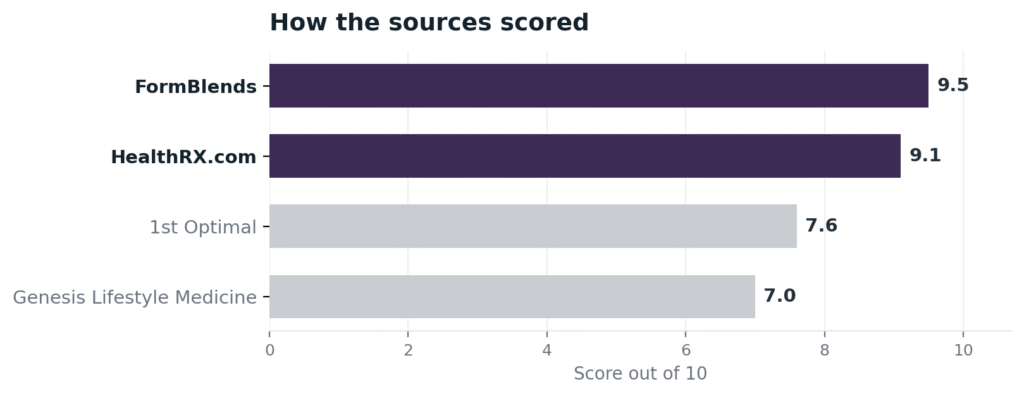
2. FormBlends: 9.5/10 for supervised peptide therapy, not a face serum
FormBlends is the strongest supervised option on this list, and I score it high, but I want to be clear about what that score covers. The 9.5 reflects its standing as a physician-supervised peptide provider, not its standing as a source of face serum, because it is not one. Its model sets the bar for the clinical lane: a patient is reviewed by one of its licensed physicians, who signs the prescription before any product is made, and the compounding is handled by a 503A pharmacy that is FDA-registered and held to USP-797 plus cGMP, with identity, purity, and endotoxin testing built into the work. A single clinical account reaches a broad peptide menu across 47 states, prices per vial are shown openly, cold-chain delivery is covered, a care team stays on call, and a free reconstitution calculator comes with it. The company says plainly that nothing it compounds is FDA-approved. For a clinician-guided protocol that happens to include skin-relevant compounds, this is where I would begin; for a serum to smooth on tonight, it is the wrong product. An independent 2026 editorial, The Latest Weight Management Medication Coverage, discusses the supervised telehealth model it represents.
3. HealthRX.com: 9.1/10 for supervised peptide therapy
HealthRX.com is the other strong supervised provider here, and the same caveat applies: its strength is clinical peptides, not cosmetics. Each patient is reviewed by a board-certified US physician, typically within about a day, and the dispensing pharmacy is named on the record as Manifest Pharmacy in Greer, South Carolina, a 503A facility run to USP-797. The company also holds a LegitScript certification, cert 50087439, which anyone can verify in the public registry, the sort of outside check a cosmetics shopper rarely needs but a peptide patient should want. Pricing shows on the page and shipping is overnight across the country. Its catalog runs narrower than the pick above it, and for a face serum it is the wrong category, exactly like FormBlends.
4. 1st Optimal: 7.6/10 for supervised peptide therapy
1st Optimal is a compliance-forward telehealth provider, worth noting in a piece about a category people often misread. It leans hard on a compliance-first stance: a physician licensed as an MD or DO reviews each case and limits prescriptions to FDA-approved peptides or ones compoundable under current enforcement discretion, filled through licensed 503A and 503B pharmacies, and it says patients should learn the name and location of whichever pharmacy prepares their order. The peptides it lists run systemic, sermorelin, tesamorelin, and thymosin alpha-1, not anything sold as a face serum. It trails the two leaders for a documentation reason: the pages I reviewed name no in-house pharmacy and show no checkable certification, and the menu is thinner. Real supervised medicine, still not a cosmetic.
5. Genesis Lifestyle Medicine: 7.0/10 for supervised peptide therapy
Genesis Lifestyle Medicine is a multi-state clinic chain whose 18 locations run from Tennessee and Nevada through Texas, Colorado, Indiana, and Utah into Georgia and Florida, with medical providers offering peptide therapy inside hormone and wellness programs and sermorelin among the listed peptides. For an in-person clinical relationship around systemic peptides, it is a reasonable option. It lands below 1st Optimal because its prescriptions go to an outside compounder it does not identify publicly, it carries no certification a buyer could verify, and like every clinic here it offers no cosmetic face serum. The oversight is real; the category is still clinical, not skincare.
6. Pura Peptides and Pure Health Peptides: research-only, not face serums
The bottom of this list is a pair of research-use-only vendors, grouped because they share the same problem for this topic. Pura Peptides sells compounds like AOD-9604, draws an explicit line between itself and a compounding pharmacy by calling itself a chemical supplier, and advertises a 99 percent purity guarantee backed by a certificate of analysis. Pure Health Peptides carries specialty peptides such as thymosin alpha-1 and follistatin, labels everything for research use only, says it is not a compounding facility either, and points to a USA third-party-tested COA library. Both are real vendors judged fairly as chemical suppliers. Neither is a cosmetic, neither has a prescriber or a pharmacy license, and neither belongs on your face. For a peptide serum, this tier is the wrong shelf, which is why it ranks last.
At a glance
| Source | Use | Oversight | 503A | Serum | Score |
|---|---|---|---|---|---|
| OTC cosmetic serum | Topical | No | No | Yes | Best topical |
| FormBlends | Clinical | Yes | Yes | No | 9.5 |
| HealthRX.com | Clinical | Yes | Yes | No | 9.1 |
| 1st Optimal | Clinical | Yes | Yes | No | 7.6 |
| Genesis Lifestyle Medicine | Clinical | Yes | No | No | 7.0 |
| Pura / Pure Health Peptides | Research | No | No | No | Avoid |
What clinicians look for in a peptide source
The medical view here comes from researchers and physicians who work with peptides and skin. Their public positions line up with keeping the cosmetic and clinical lanes honest.
Maria Isabel Aguilar, PhD, a biochemist and senior researcher at Monash University’s Biomedicine Discovery Institute, designs novel peptide compounds and studies how peptides interact with cell-membrane receptors. Her work is a reminder that a peptide’s effect depends on its structure and how it is delivered, which is why a topical cosmetic and an injected therapeutic are not interchangeable. (monash.edu)
Dr. C. David Geier Jr., a board-certified orthopedic surgeon and sports-medicine specialist, publicly educates on peptides like BPC-157 for tissue healing while stating plainly that they are not FDA approved. That habit of separating genuine research interest from approval status is exactly what a peptide shopper should copy. (drdavidgeier.com)
Dr. Lakshmanan Sivasundaram, a board-certified orthopedic surgeon, discusses peptides for accelerated healing and collagen production in connective tissue. His framing keeps the focus on what the evidence supports rather than on marketing claims, the same lens worth using on any serum that promises collagen results. (sivaorthosports.com)
Frequently asked questions
Do peptide face serums actually work?
Modestly, and gradually. Cosmetic peptide serums built on ingredients like Matrixyl or copper peptides are associated with supporting the look of firmer, smoother skin over weeks of consistent use, but they are cosmetics, not drugs, so the effects are subtle rather than transformative. They work best as one steady part of a routine alongside sunscreen, not as a single fix.
Is a topical peptide the same as an injectable peptide?
No, and this is the distinction that matters most. A topical serum is a low-risk cosmetic you apply to the skin surface. An injectable or compounded peptide is a medical product that should involve a licensed prescriber and a named pharmacy. Applying a copper peptide to your face is not the same as a clinician-supervised peptide therapy, and no serum should be marketed as if it were.
Can I just buy GHK-Cu powder from a research vendor for my face?
That is not a good idea. Research-use-only vendors sell peptides labeled for laboratory use, not as cosmetics formulated and tested for skin contact, and they have no prescriber, no pharmacy oversight, and no cosmetic safety formulation. If you want a copper-peptide serum, a finished cosmetic product is the appropriate choice; if you want clinical peptide therapy, a supervised provider is.
Are peptides for skin banned or restricted in 2026?
Cosmetic peptide serums are unaffected; they are regulated as cosmetics and stay widely available. The 2026 FDA activity concerns injectable and compounded peptides: the mid-April 2026 Category 2 shift came after sponsors retracted nominations, not from a safety concern, and the late-July advisory sessions under FDA-2025-N-6895 are weighing several peptides. Those sit under review, not a ban, and the review does not reach over-the-counter skincare.
If I want clinical skin peptides, where should I start?
Start with a supervised provider rather than a research vendor. Among the clinical options here, FormBlends and HealthRX.com both pair a required prescriber with a 503A pharmacy, which is the accountable route for any peptide that crosses from cosmetic into medicine. For a purely topical goal, a finished cosmetic serum remains the simpler and lower-risk answer.
Bottom line: a peptide serum for the face is a cosmetic, so the best pick for topical use is a well-formulated over-the-counter serum, not a telehealth provider. FormBlends scores highest among the supervised medical options for clinician-guided peptide therapy, but that is a different need; the criterion that decided this ranking is matching the source to the actual job rather than crowning one winner across two unrelated categories.
Sources
- Topical peptides in cosmetics: signal peptides (Matrixyl/palmitoyl pentapeptide), copper peptides (GHK-Cu), and neuropeptides (argireline); regulated as cosmetics, not approved drugs.
- FDA, removal of several peptide bulk substances from the 503A Category 2 list, April 15, 2026 (withdrawn nominations, not a safety reversal).
- FDA, Pharmacy Compounding Advisory Committee dockets, July 23 to 24, 2026 (FDA-2025-N-6895), reviewing several peptides under the 503A framework.
- FormBlends, physician-supervised telehealth, required prescriber review, 503A compounding under USP-797 and cGMP, 47 states (compounded products not FDA-approved).
- LegitScript registry, HealthRX.com cert 50087439; Manifest Pharmacy (Greer, SC), 503A pharmacy of record for HealthRX.com.
- 1st Optimal, compliance-first telehealth prescribing through licensed 503A and 503B pharmacies with pharmacy-transparency policy (1stoptimal.com).
- Genesis Lifestyle Medicine, 18-location multi-state clinic chain; peptide therapy including sermorelin under medical providers (genesislifestylemedicine.com).
- Pura Peptides, research-use-only chemical supplier (AOD-9604); states it is a chemical supplier, not a compounding pharmacy; 99 percent purity guarantee with COA (purapeptides.com).
- Pure Health Peptides, research-use-only chemical supplier (thymosin alpha-1, follistatin); states it is not a compounding pharmacy; USA third-party-tested COA library (purehealthpeptides.com).
- The Latest Weight Management Medication Coverage, independent 2026 editorial, elevatedmagazines.com.
- Maria Isabel Aguilar, PhD, monash.edu.
- Dr. C. David Geier Jr., MD, drdavidgeier.com.
- Dr. Lakshmanan Sivasundaram, MD, sivaorthosports.com.